PC Monitors
ASUS ProArt PA32UCDM — Creator QD-OLED Monitor (2026)
source not recorded
source not recorded
source not recorded
Community verdict
The PA32UCDM is the community's creator-OLED reference: TechRadar's #1 photo-editing pick, a colorist blog's affordable grading-monitor recommendation, and a viral creator Short — all anchored by hardware calibration, Dolby Vision, and QD-OLED blacks at a street price that has now dropped ~$400 from launch. It's the pick for color-critical photo/video/HDR work at a Mac-adjacent price. Pass if you need silent operation (audible fan), DisplayPort input, rich USB-A connectivity, or near-100% Adobe RGB for print — that's where BenQ PD3225U, Dell U3225QE, or Eizo ColorEdge trade better.
Price
| MSRP | Current street (observed 2026-09-20) |
|---|---|
| $1,899 launch (CineD, TFTCentral, B&H, March 2025); ASUS's Feb 2025 availability release said "MSRP of US$1699" — conflicting | ~$1,499–$1,599 US (us.smartprix $1,599, crawled Sept 2026; pricehistory.app/Amazon current $1,599, with drops to $1,399–$1,489 through 2026); B&H listing still shows $1,899 (likely stale; CineD noted a $200-off coupon at B&H earlier); SHI $1,895 (stale business listing); UK Currys £1,099 (54-day-old crawl — likely stale) |
- Price trajectory: ~$1,899 → $1,699 (Jan 2026) → $1,399–$1,499 (Apr–Aug 2026) → $1,599 (Sept 2026). The display has settled ~$300 below launch; at ~$1,500 it's ~$600 cheaper than the gaming-equivalent PG32UCDM at its launch price and the cheapest way into a calibrated 32" 4K QD-OLED creator monitor.
The full dossier
Research date: 2026-09-20. Prices and claims dated below; re-verify live before purchase.
1. Overview
The ASUS ProArt PA32UCDM is ASUS's 32" 4K QD-OLED professional monitor and the creator community's 2026 "OLED moment" pick. Model name confirmed exact by asus.com, Best Buy (SKU 12183776/12936288), and every reviewer — no substitution needed.
Corrections to the coordinator's brief (2026-09-20):
- Power delivery is 96W (ASUS official spec), not 90W. TechRadar's guide text says "90W" in one passage but its review spec box and ASUS's own tech-spec page agree on 96W.
- Pricing: $1,899 was the launch price (B&H, March 2025 — CineD, TFTCentral). ASUS's own Feb 2025 availability press release stated "MSRP of US$1699" (conflicting sources; both dated). Current US street is ~$1,499–$1,599 as of Sept 2026, so the "$1,899 at B&H" figure is stale for today's street.
It uses the same Samsung Display 32" 4K QD-OLED Gen-3 panel as the gaming trio (PG32UCDM / MPG 321URX / AW3225QF) but wrapped in the ProArt feature set: full color-space presets, hardware calibration (Calman + Light Illusion ColourSpace), dual Thunderbolt 4 with daisy-chaining, and Dolby Vision — the first ASUS PC monitor with it. Part number 90LM03HE-B01K70.
2. Social standing
Platforms: review outlets (TechRadar #1 photo-editing pick), creator channels (CineD, Capture magazine, viral YouTube Short), colorist community (Jonny Elwyn blog), Reddit/r/Monitors via open web (thin), Threads (thin — no monitor enthusiast surface per pulse).
- TechRadar (best-monitor-for-photo-editing guide, refreshed ~June 2026): "The Asus ProArt PA32UCDM is the best monitor for photo editing we've tested." Reasons to buy: perfect per-pixel lighting control, sizzling HDR highs, strong feature set. Reasons to avoid: OLED panel has limitations, slightly mediocre factory calibration, no DisplayPort input. Measured 95.7% Adobe RGB in the guide (vs ASUS's marketing focus on DCI-P3).
- PCWorld (Matthew Smith, in-depth review): "great choice if you want a QD-OLED monitor for creative professional work" but "the monitor could benefit from more connectivity... Competitors like the Dell UltraSharp U3225QE and BenQ PD3226G don't match the PA32UCDM's image quality, but they offer numerous extra ports." Confirmed audible cooling fan: "you will hear it if you're using the monitor in a quiet room. It's not very loud, and the fan noise wasn't grating, but it was noticeable." Also measured 97% DCI-P3 / 94% Adobe RGB (slightly under ASUS's 99% claim) and found out-of-box gamma 2.2 and 6400K "close to ideal."
- CineD (creator channel): "The PA32UCDM doesn't just check boxes. It hits a sweet spot for post pros needing accuracy, HDR, and connectivity... the first PC monitor from ASUS with Dolby Vision certification, offering more precise tone mapping and specular highlight control for HDR workflows."
- Capture magazine (photographer Drew Hopper): 5/5 for setup, features, image quality — "excels in colour accuracy, deep contrast, and a fast 240Hz refresh rate... ideal for photo processing, colour grading, and fine-tuning in Lightroom" — but 4/5 value at AU$2,799.
- Jonny Elwyn (film-editor/colorist blog, May 2026 update): "My recommendation for an affordable colour grading monitor in 2026 would be the ASUS ProArt PA32UCDM... professional hardware calibration options that will make it a truly reliable reference for SDR colour grading... All for around $1700/£1300."
- whoismcafee (Sept 2026 video-editing roundup, after 3 months of testing 10 monitors): "If you're a professional colorist or HDR filmmaker who needs genuine HDR performance, the ASUS ProArt PA32UCDM with QD-OLED is worth the premium investment. The perfect blacks and Dolby Vision support deliver grading accuracy that IPS monitors can't match."
- YouTube Shorts: viral "The PERFECT monitor for creators" short after 2 months of use (per phase-1 pulse) — this is what made it a creator-community phenomenon, not a spec sheet.
Recurring knocks: (1) audible fan (PCWorld confirmed; the passive-cooled PG32UCDM gaming sibling draws envy here); (2) factory calibration not quite reference (TechRadar's "slightly mediocre"; PCWorld's Adobe RGB measurements below spec); (3) sparse ports — no DisplayPort input, only one downstream USB-A, so many owners still need a dock (PCWorld); (4) 240Hz is a debated novelty on a creator monitor; (5) burn-in anxiety persists despite OLED Care (proximity sensor, pixel shifting, screen saver) — the Threads WOLED-burn-in thread is the community counterweight, though this is QD-OLED, not WOLED. (6) Adobe RGB coverage of ~94–95.7% measured is good but not the 99%+ a print photographer gets from Eizo — note for print work.
3. Key specs table
| Spec | ASUS ProArt PA32UCDM | Source |
|---|---|---|
| Panel type | 31.5" QD-OLED (Samsung Display Gen-3), flat, anti-reflection coating | asus.com tech specs |
| Resolution / PPI | 3840×2160, 140 PPI, true 10-bit (1073.7M colors) | asus.com; ASUS press |
| Refresh / response | 240Hz max, 0.1ms GTG, Adaptive-Sync VRR | asus.com |
| Brightness | 250 nits typical (full screen); 1,000 nits HDR peak (3% area) | asus.com; ASUS press release |
| Contrast | 1,500,000:1 (HDR max) | asus.com |
| Color gamut | 100% sRGB, 99% DCI-P3 (ASUS); Adobe RGB: 95.7% (TechRadar), 94% (PCWorld measured) — UNVERIFIED as official figure; ASUS lists Adobe RGB only as a preset | asus.com; TechRadar; PCWorld |
| Factory calibration | ΔE < 1 claimed, includes factory calibration report in box; TechRadar's hands-on found it "slightly mediocre"; PCWorld measured gamma 2.2 / 6400K — "hard to discern" from ideal | asus.com; TechRadar; PCWorld |
| Hardware calibration | Yes — ASUS ProArt Hardware Calibration, works with Calman and Light Illusion ColourSpace, Windows + Mac, profiles written to monitor IC; ProArt Color Center for network/studio calibration scheduling | ASUS press release; asus.com |
| HDR | Dolby Vision, HDR10, HLG; VESA DisplayHDR True Black 400; HDR Preview mode; multiple HDR modes (HDR_PQ/HLG × DCI/BT.2020) | asus.com |
| Color presets | sRGB, Adobe RGB, DCI-P3, BT.2020, Rec.709, DICOM, Native, Dolby Vision, 3× User modes; ProArt Palette; gamma 1.8/2.0/2.2/2.4/2.6; 5 color-temp modes; QuickFit Plus; PIP/PBP | asus.com |
| Ports | 2× Thunderbolt 4 (daisy-chain), 1× HDMI 2.1 (FRL, full 48Gbps); USB hub: 1× USB 3.2 Gen2 Type-C + 1× USB 3.2 Gen2 Type-A; no DisplayPort input; HDCP 2.3 | asus.com; TechRadar; PCWorld |
| USB-C PD | 96W (one TB4 port) | asus.com (TechRadar's "90W" passage conflicts — 96W is the official figure) |
| KVM | Not advertised on asus.com — UNVERIFIED / effectively absent | — |
| Speakers | 2× 3W | asus.com |
| Ergonomics | Tilt +20°/−5°, pivot ±90°, height 0–130mm; no swivel; VESA 100×100mm (bracket included per TechRadar) | asus.com; TechRadar |
| Sensors / OLED care | Ambient light sensor, proximity sensor (auto-dim), ASUS OLED Care (screen saver, pixel shifting) | asus.com |
| Cooling | Active fan (audible in quiet rooms per PCWorld) | PCWorld |
UNVERIFIED: whether the ASUS official Adobe RGB coverage figure exists (not published; only third-party measurements); burn-in coverage terms in the ASUS warranty; whether the Newegg/retailer box-content list (below) is exhaustive.
4. Pricing
| MSRP | Current street (observed 2026-09-20) |
|---|---|
| $1,899 launch (CineD, TFTCentral, B&H, March 2025); ASUS's Feb 2025 availability release said "MSRP of US$1699" — conflicting | ~$1,499–$1,599 US (us.smartprix $1,599, crawled Sept 2026; pricehistory.app/Amazon current $1,599, with drops to $1,399–$1,489 through 2026); B&H listing still shows $1,899 (likely stale; CineD noted a $200-off coupon at B&H earlier); SHI $1,895 (stale business listing); UK Currys £1,099 (54-day-old crawl — likely stale) |
- Price trajectory: ~$1,899 → $1,699 (Jan 2026) → $1,399–$1,499 (Apr–Aug 2026) → $1,599 (Sept 2026). The display has settled ~$300 below launch; at ~$1,500 it's ~$600 cheaper than the gaming-equivalent PG32UCDM at its launch price and the cheapest way into a calibrated 32" 4K QD-OLED creator monitor.
5. What's included / what's needed
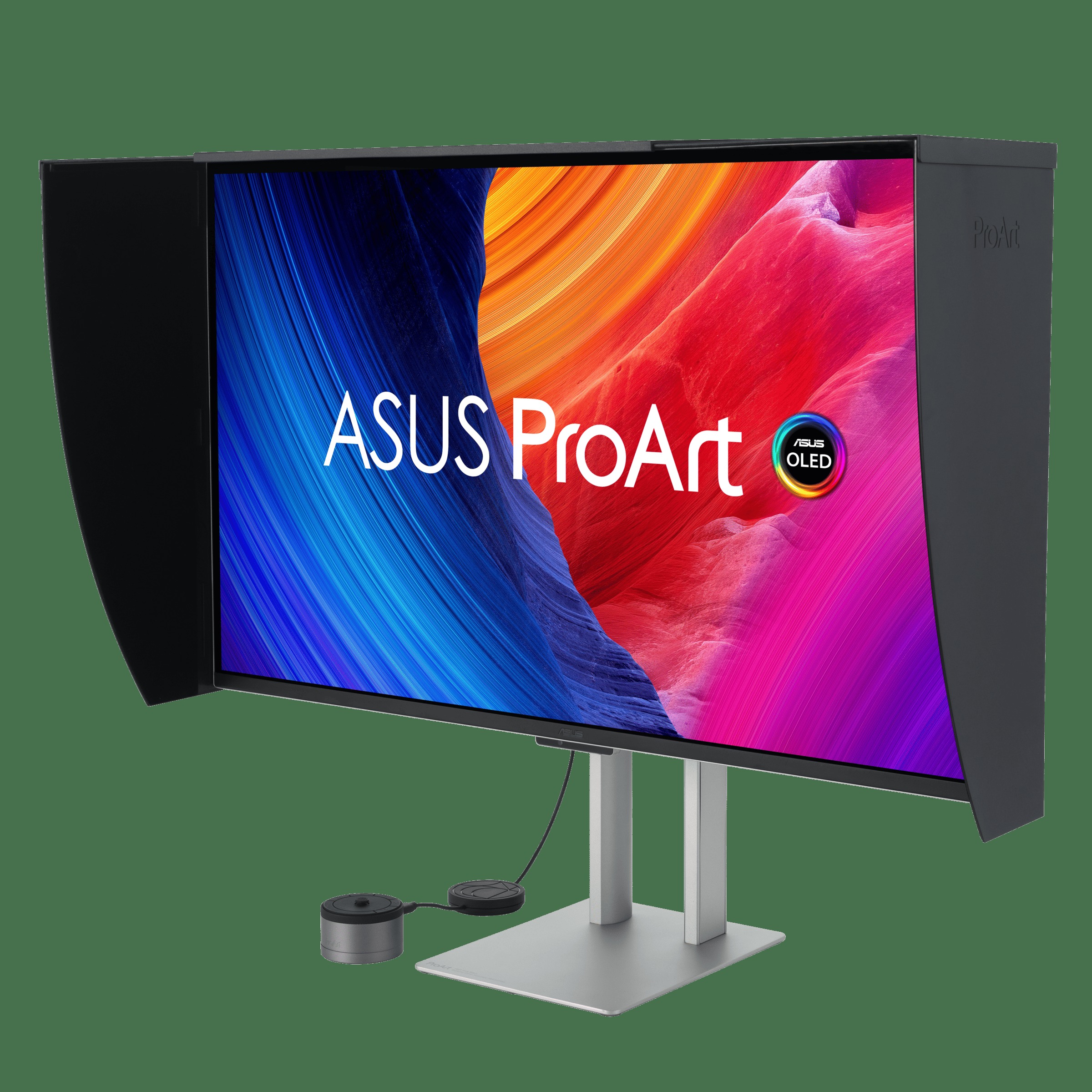
- In the box (retailer-sourced from us.smartprix spec sheet, not verified on asus.com): monitor, factory color pre-calibration report, HDMI Ultra High Speed cable, power cord, quick-release stand, quick start guide, Thunderbolt 4 cable, USB-C to A cable, warranty card, welcome card. ASUS's official press render shows a shading hood + control dial — UNVERIFIED whether the hood is included, optional, or from a different model.
- Need separately: a colorimeter (X-Rite i1/Calibrite) for hardware calibration — no built-in colorimeter (unlike the Eizo ColorEdge or the ProArt PA32UCE's motorized one); likely a USB-C/Thunderbolt dock for multi-device setups given the sparse downstream ports; no DisplayPort cable needed (no DP input at all).
6. Support reality
- Warranty: 3 years (US retail listings: us.smartprix "3 Year Warranty", versus.com ASIN listing "3 yr Warranty"; part 90LM03HE-B01K70). Confirm burn-in coverage language on the ASUS US warranty page at purchase — UNVERIFIED whether OLED burn-in is explicitly covered.
- Reputation: ASUS monitor support is generally regarded as a step below Dell's in the owner community — the phase-1 pulse notes Dell's "well-regarded support" as a specific Alienware/AW3225QF selling point, while ASUS's comparable sentiment is absent. CineD's creator commenter reports personal satisfaction with ProArt displays; Capture magazine praised ASUS OLED Care. No community evidence of ASUS support failures on this model; the contrast is relative, not absolute.
- Firmware/support cadence: Dolby Vision shipped ready at launch (earlier coverage flagged a 2025/Q3 firmware timeline — resolved, per current reviews). No firmware-quality complaints surfaced in this pass.
7. Community verdict
The PA32UCDM is the community's creator-OLED reference: TechRadar's #1 photo-editing pick, a colorist blog's affordable grading-monitor recommendation, and a viral creator Short — all anchored by hardware calibration, Dolby Vision, and QD-OLED blacks at a street price that has now dropped ~$400 from launch. It's the pick for color-critical photo/video/HDR work at a Mac-adjacent price. Pass if you need silent operation (audible fan), DisplayPort input, rich USB-A connectivity, or near-100% Adobe RGB for print — that's where BenQ PD3225U, Dell U3225QE, or Eizo ColorEdge trade better.
Images
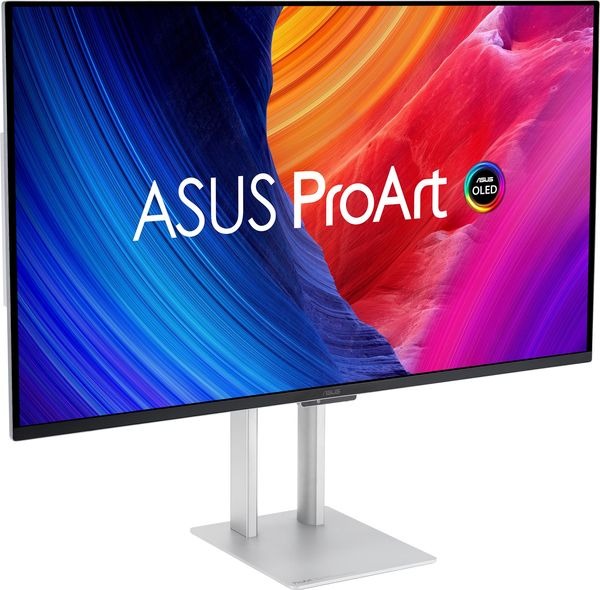
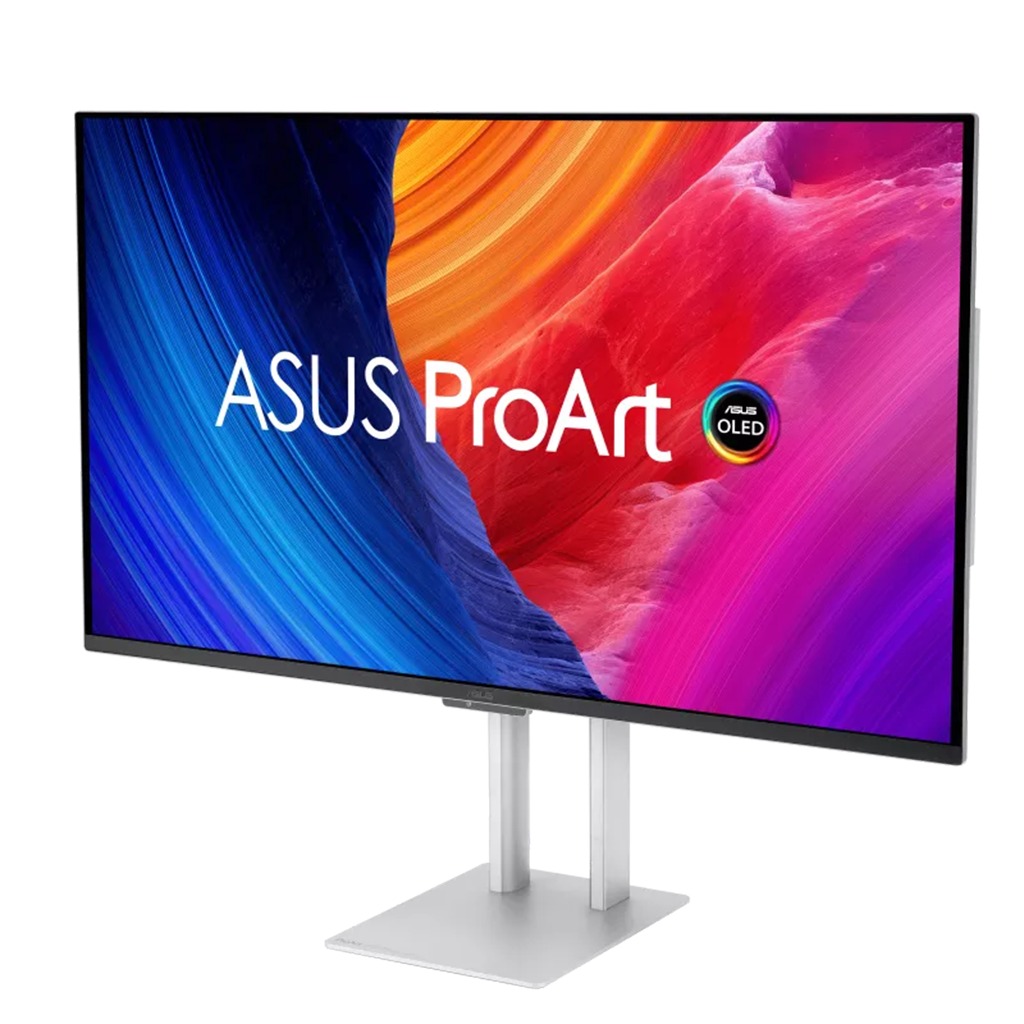
monitor-asus-proart-pa32ucdm-1.jpg— ASUS official press render (hood + control-dial variant) from dlcdnwebimgs.asus.commonitor-asus-proart-pa32ucdm-2.jpg— exact-model product shot (dual silver stand) from son-video.commonitor-asus-proart-pa32ucdm-3.jpg— exact-model product shot (dual silver stand) from mwave.com.au retailer catalog- Variant note: a Newegg portrait render fetched during gathering was rejected — it depicted an older ProArt chassis with side-mounted control buttons (mislabeled or wrong variant) and is not this model.
The review
ASUS ProArt PA32UCDM Review
The creator community's OLED moment, with a fan in it.
The ASUS ProArt PA32UCDM is the monitor that made color people take QD-OLED seriously: a 32" 4K Gen-3 QD-OLED panel wrapped in ProArt's professional feature set — hardware calibration, Dolby Vision, dual Thunderbolt 4 — at a street price that's fallen to ~$1,500. TechRadar calls it "the best monitor for photo editing we've tested." A colorist blog recommends it as the affordable grading monitor for 2026. A YouTube Short calling it "the PERFECT monitor for creators" went viral. And then PCWorld confirmed the thing nobody wanted to hear: you can hear its cooling fan in a quiet room. The gaming sibling, the PG32UCDM, is fanless. The creator one isn't. That's the review's central irony, and everything else is detail work.
What's genuinely good is the professional package. Hardware calibration that works with Calman and Light Illusion ColourSpace, with profiles written to the monitor's own IC — the thing that makes it "a truly reliable reference for SDR colour grading," in colorist Jonny Elwyn's words. It's the first ASUS PC monitor with Dolby Vision certification, which CineD's creator coverage says gives "more precise tone mapping and specular highlight control for HDR workflows." Dual Thunderbolt 4 with daisy-chaining and 96W power delivery (ASUS's official figure — TechRadar's guide text says 90W in one passage, but the spec box and ASUS agree on 96W). 99% DCI-P3, true 10-bit, a factory calibration report in the box. And the street price has done the real marketing: $1,899 at launch in March 2025, ~$1,399–1,499 through mid-2026, sitting ~$1,599 now. At ~$1,500 it's the cheapest way into a calibrated 32" 4K QD-OLED creator monitor, and the creator press — Capture magazine's 5/5 on image quality, whoismcafee's verdict after three months testing ten monitors — keeps landing in the same place.
Now the knocks, because a creator monitor gets judged harder than a gaming one. The fan: PCWorld confirmed it — "you will hear it if you're using the monitor in a quiet room. It's not very loud, and the fan noise wasn't grating, but it was noticeable." In a color suite or a quiet edit bay, noticeable is noticeable. Factory calibration is the second one: TechRadar's hands-on called it "slightly mediocre," and PCWorld measured 97% DCI-P3 / 94% Adobe RGB against ASUS's 99% DCI-P3 claim — fine, but "reference monitor" is doing some lifting there. Which brings the third: Adobe RGB coverage lands around 94–95.7% measured, and ASUS doesn't publish an official figure at all. If you do print work, that's not the 99%+ an Eizo gives you — know your color space before you buy. Fourth, the ports: no DisplayPort input at all, one downstream USB-A, and KVM effectively absent (not advertised, UNVERIFIED). PCWorld's verdict stung: "the monitor could benefit from more connectivity." Most owners will still need a dock. Fifth, the 240Hz refresh rate is a debated novelty on a creator monitor — don't pay the OLED premium for speed your color work will never use. Sixth, there's no built-in colorimeter (unlike the ProArt PA32UCE's motorized one or an Eizo ColorEdge), so hardware calibration means buying a probe separately — and whether the shading hood in ASUS's press renders is included or optional is UNVERIFIED.
Two pricing honesty notes. ASUS's own February 2025 availability release said MSRP $1,699; launch coverage said $1,899 — conflicting, both dated, neither is today's price. And B&H still lists $1,899, which is stale. The real number is ~$1,499–1,599. Also: burn-in coverage terms in the ASUS warranty are UNVERIFIED — the 3-year warranty is confirmed, the explicit burn-in language is not. The Threads WOLED-burn-in thread is the community's counterweight to every OLED-for-work pitch, even if this is QD-OLED, not WOLED; the anxiety is real even when the chemistry differs.
Who should skip it: anyone working in a genuinely quiet room (the fan); anyone whose workflow needs DisplayPort input (it doesn't exist here); print photographers needing near-100% Adobe RGB; anyone who needs rich USB connectivity without buying a dock; and anyone being asked to pay $1,899 — that price is dead.
The social pulse, in one paragraph: creator channels and review outlets carry this one — TechRadar's #1 photo-editing pick, CineD, Capture, the colorist blogs, the viral Short — while Reddit and Threads are thin. It's the opposite distribution from the gaming monitors: press and pros love it, the forum owner layer is shallow. ASUS monitor support is generally regarded as a step below Dell's in the owner community; no support failures surfaced on this model, but the contrast is relative and worth knowing.
Value call: ~$1,500 street versus $1,899 launch is $400 of patience paying off, and it's ~$600 under the gaming PG32UCDM's launch price for a more complete creator feature set. The alternatives that trade better on specific needs: BenQ or Dell UltraSharp for ports, Eizo for print-grade Adobe RGB, the LG dual-mode WOLEDs if 240Hz actually matters to you. At $1,500 for calibrated 4K QD-OLED with Dolby Vision, though, nothing else is playing in this lane.
A reference-grade panel with a prosumer fan and prosumer ports. Buy it for the calibration and the blacks; budget for the dock, the probe, and the room tone.
Prices and claims observed 2026-09-20; re-verify live before purchase.